
Does Subliminal Advertising Work?
We attempted to reconstruct a famous 1950s experiment with subliminal advertising by inserting very brief flashes of certain words in this video clip. Take a look at this video with subliminal messages: can you tell what the words say?


The Power to Do More

Every time I see this, I wonder if it shouldn't be the exact opposite.
Nobody sells the dishwasher promising people that now, finally, they can do more dishes.
The washing machine rumbling in my basement means me doing less laundry on a washboard by the river.
The Nest thermostat promises I won't ever have to touch a thermostat again.
Roomba takes doing out of vacuuming.
Has there been an ad for the iPhone where people have a phone conversation? Since I got mine in 2007, my phone bill has been averaging about three voice minutes per day, for which I am forever grateful. Tweeting, Facebooking and messaging have replaced the hard stuff.
I am struggling to think of a single thing I would want to do more of on a computer.
I would like to be sending fewer emails. I also would like having to delete fewer of them. I would like for a computer to notice if I keep deleting something without reading.
I like taking pictures, but I would like to spend less time organizing and retouching them.
I don't want to do more Excel formulas. I want to type in "how likely are people who peel bananas from the handle end to have red hair and two kids", and get an answer without having to do more pivots, smart filters, regressions, or whatever.
First I thought I would definitely like to play computer games more. Then I thought of all the games I quit in mid-level because of how inflexibly, frustratingly and randomly difficult for my inferior thumb reflexes they would eventually become. It would be nice if games could sense my frustration and lower their guard a bit and let me through. It would be nice if a game would just let me play it my way instead of insisting that I do what feels a lot like work.
Hey, computer! It's your memory that doubles every two years while mine probably degrades at about the same rate. So I think you should be doing more.
What I would like for myself is the power to do less.
I Miss My Old Media
I miss all the news that fit to print -- not all the news, and pseudo-news, and churnalism, and press releases published verbatim, and gossip, and updates to gossip, and galleries, and listicles that drive just one more page view.
I miss editors who say no.
I miss reading Playboy -- or anything -- for the articles.
I miss cutting things out to save them for later.
I miss ads that sell hard from a full spread and feel good about it; ads that don't stalk you, and nag you, and creep you out.
I miss hearing from my friends once a year and spending all night catching up and telling them how much their kids have grown since I'd last seen them because the last I'd seen them was a year ago.
I miss organically yellowed pictures.
I miss the way old film cameras used to smell.
I miss having just one TV remote on my couch.
I miss turning the dial on my radio, and hearing crackling, and static, and then catching a faint song that sounds like it's played thousands of miles away because it is.
I miss songs on the radio being selected by someone but a playlist algorithm.
I miss knobs, and buttons, and dials, and switches.
I miss running to my mailbox and finding a handwritten letter.
I miss editors who say no.
I miss reading Playboy -- or anything -- for the articles.
I miss cutting things out to save them for later.
I miss ads that sell hard from a full spread and feel good about it; ads that don't stalk you, and nag you, and creep you out.
I miss hearing from my friends once a year and spending all night catching up and telling them how much their kids have grown since I'd last seen them because the last I'd seen them was a year ago.
I miss organically yellowed pictures.
I miss the way old film cameras used to smell.
I miss having just one TV remote on my couch.
I miss turning the dial on my radio, and hearing crackling, and static, and then catching a faint song that sounds like it's played thousands of miles away because it is.
I miss songs on the radio being selected by someone but a playlist algorithm.
I miss knobs, and buttons, and dials, and switches.
I miss running to my mailbox and finding a handwritten letter.
New York Agency To Host Competition for Marketing Technology Start-ups
A note from EDGE Collective:
On September 27, EDGE Collective is hosting their inaugural event Expand My Brand, an all day symposium matching up today’s top brands with emerging technologies and startups to explore how social technology is impacting brand marketing and advertising. At the end of the event there will be a startup competition where 5 new emerging startup technologies will pitch their product to a panel of brands and thought leaders, Shark Tank style, for a chance to win $30,000 in startup assets from EDGE Collective.
Buy your tickets here.
If you have a startup and are interested in participating, click here.
On September 27, EDGE Collective is hosting their inaugural event Expand My Brand, an all day symposium matching up today’s top brands with emerging technologies and startups to explore how social technology is impacting brand marketing and advertising. At the end of the event there will be a startup competition where 5 new emerging startup technologies will pitch their product to a panel of brands and thought leaders, Shark Tank style, for a chance to win $30,000 in startup assets from EDGE Collective.
Buy your tickets here.
If you have a startup and are interested in participating, click here.
We Must Blaze A Trail To New Media [1946]

Found a small stack of PDFs of scans of old issues of Grey Matter, Grey's research newsletters the agency sent out to media ("since 1935"). Particularly cool is a 1997 retrospective (pdf) of what Grey had published about television over the years.
From a 1946 issue:
"Throughout the still-raging dispute concerning the precise position television will occupy in the advertising firmament, a point has been missed... television is just one phase of a new advertising age (we might call) the "electronic age" of advertising...
We hope we will not be charged with being anti-newspapers, anti-magazines or any of the established media... but we see a brilliant future for radio, for television, for (other electronic media). And we would be sadly remiss in our duty to advertising... to clients.. to future clients if we did not firmly resolve to explore those new media intensively and utilize them to the maximum of their potentials."
Going to ARF's Audience Measurement Conference
For a recent experiment, we divided respondents into two groups. To both groups, we showed a trailer for an upcoming movie. One group was given two different descriptions for the trailer (as if there were two different trailers) and asked to chose one or the other. We have found that the presence of this "choice" had a significant effect on recall of key facts from the trailer. We are doing some follow-up work now to clarify a few things, but what we found was pretty interesting.
My colleague Rob St.Louis and I are going to the ARF's Audience Measurement conference in New York in June to present a paper with the results. Come say hi if you are there. Our thing starts at 1.50pm on Monday June 11 in Majestic on the 6th floor of, I think, Marriott Marquis.
Oh, and we have also just published the results of another study that showed how fiddling with smartphones distracts people from TV and what could be done about it
My colleague Rob St.Louis and I are going to the ARF's Audience Measurement conference in New York in June to present a paper with the results. Come say hi if you are there. Our thing starts at 1.50pm on Monday June 11 in Majestic on the 6th floor of, I think, Marriott Marquis.
Oh, and we have also just published the results of another study that showed how fiddling with smartphones distracts people from TV and what could be done about it
A Cheat Code in Halo 4 Box Art Puzzle

Microsoft unveiled the box art for the upcoming Halo 4 game by emailing Xbox community members one of the 32 pieces of puzzle that when assembled together reveal the image. The puzzle was cracked in about an hour, probably helped by the fact that the remaining 31 pieces could be seen by changing the last two digits of the image URL before the ".jpg" part, a fact that wasn't lost on the fans:
http://image.engage.xbox.com/lib/feca167070610c7c/m/4/12993-H4_02.jpg

Google's Screenwise Project Listens To TV Habits

Google's Screenwise research project announced back in February is designed to collect data on more than just Internet behavior. In addition to custom wireless routers that gather information on participants' browsing and downloading habits, the recently mailed recruiting brochure describes a device "a little bigger than a smartphone" called Screenwise TV Tab. TV Tab "captures audio signals that enables the study to identify which TV programs are being viewed."
The information TV Tab collects includes:
- Identity of person logging into the Screenwise TV Tab
- Timestamps indicating time of log-in and log-out
- Duration of television usage per session
- The total amount of time a television is used in the household
I haven't seen the device, but I think it could be based on Android and powered by this TV Tab app developed by Mobile Research Labs. Android market lists the number of installs for this app at between 10 and 50.

In addition, a different Screenwise app (which looks like a version of Lumi's AnalyzeMe) captures participants' smartphone habits. Among the more interesting things the app collects are:
- Frequency of use of device calendar
- Battery status
- Whether you are using your smartphone inside or outside your home
- How long music is played, and the title and artist for each song
- Timestamp and duration of any video viewed on smartphone
- all URL's and advertisements viewed
- When a Panelist opens or closes an application
Google, who is conducting this research together with GfK, is offering a sign-up incentive of $100 with up to an additional $50 for each month the participating household stays in the study.
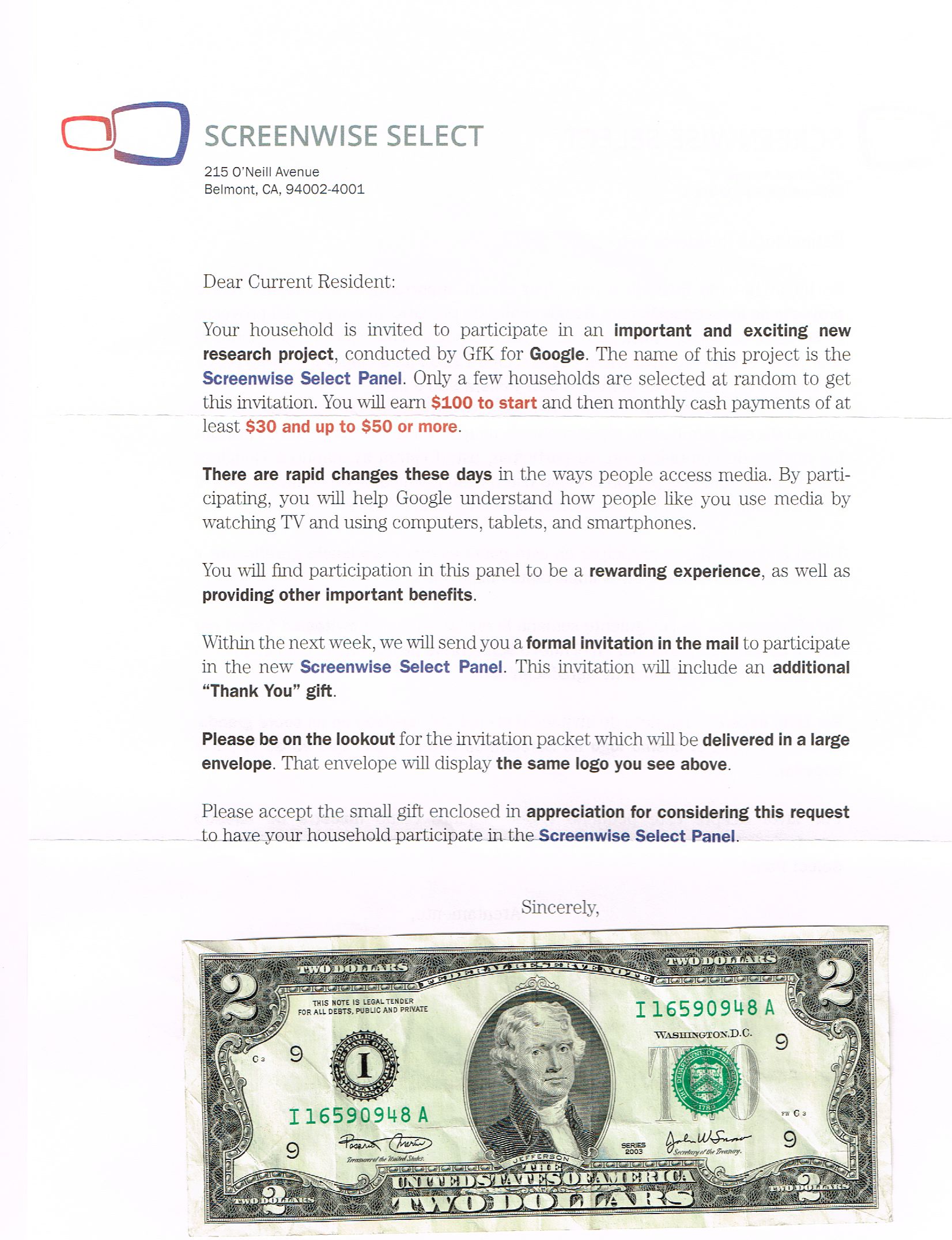
Some people who were randomly selected to receive a recruiting mailer (accompanied with a crispy two-dollar bill), are concerned it might be a scam, or worse: "The money is real too! A $2 Dollar bill? SO weird man... never heard of anything like this."
In Case of Emergency, Eat This Book

Land Rover in the United Arab Emirates printed 5,000 edible copies of a desert survival guide. Twenty-eight pages of potato-based starch paper have a slightly sugary taste from the glycerin-based ink and are bound by a spiral that can be used as skewers. The book comes in a reflective cover that can be used to send help signals.
-- Y&R Dubai; thank you, Guillaume
Pinnable Ads

Saw this page on AdKeeper, the company that is trying to make online advertising bookmarkable. This could be an interesting way for Pinterest itself to make money: becoming a network for ads that people will want to hold on to. Won't be a huge stretch for them, most of the pins are already very ad like. You will easily find pins for a book, iPhone app, music, movie posters and trailers, and even payday loans.
And I already see people pinning coupons. Here's one from Jiffy Lube someone has pinned after filing out a satisfaction survey.

Subscribe to:
Posts (Atom)